
[Interview] SNUAILAB: low-resolution images are no problem… “Providing the SIRNet-based ‘AutoCare’ platform”
CEO Myungho Yoo: “We will expand vision AI application solutions through our products and platform”
[Industry News, reporter Cho Chang-hyun] One area of automation where artificial intelligence (AI) is standing out is machine vision. Having matured in industries such as semiconductors and displays, AI machine vision is now extending its reach to secondary batteries, an emerging next-generation industry. As competition in the sector intensifies, SNUAILAB (CEO Myungho Yoo, SNU AI LAB), a joint venture in which Seoul National University's technology holding company participates, is drawing attention with a vision AI service distinguished by application and customization.
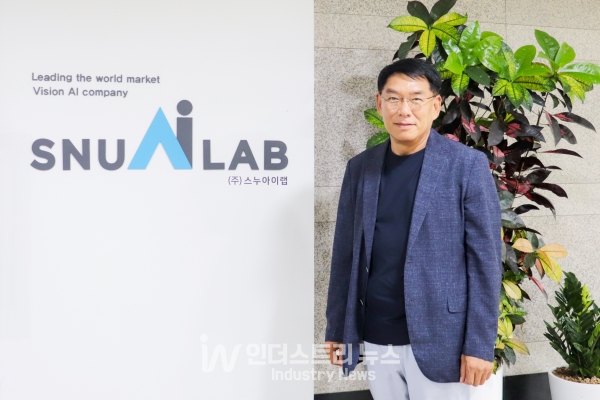
SNUAILAB CEO Myungho Yoo said, “SNUAILAB will keep working to build solutions that can be used on the manufacturing floor.” [Photo: Industry News]
“SNUAILAB is an official subsidiary of Seoul National University, established with equity participation from the university's technology holding company and its professors,” said Yoo. “We have developed a machine learning application platform that serves as the foundation for applying vision AI technology, and we provide a variety of application solutions to customers.”
In fact, six Seoul National University professors who are authorities in computer vision and big data processing, along with key researchers formerly at Samsung, took part directly in founding SNUAILAB. Noting that vision application requirements vary by industry, the company has since been collaborating with the university's research infrastructure and its master's and doctoral researchers, and continues its efforts to secure basic and foundational technologies and link them into a platform.
The visible results are also remarkable. This year the company grew into a ‘Baby Unicorn 200’ selected by the Ministry of SMEs and Startups. “Being selected for Baby Unicorn 200 feels like our first step toward becoming a world-class AI company,” Yoo said. “We see this as a new beginning, and we will expand application solutions for vision AI through the products and platform we have prepared and developed so far.”
Supplying solutions equipped with ‘SIRNet’ for high-quality images
SNUAILAB provides Safety Vision solutions required for industrial safety and Machine Vision solutions needed for vision inspection equipment on the manufacturing floor. It also supplies the AutoCare platform, which can deliver a variety of field-oriented vision AI solutions.
“Deep learning AI development requires repetitive processes such as data cleansing and training to reach final model performance,” Yoo advised. “Customers need to develop AI models on a platform to make it economical.” He added, “To supply solutions that meet customer needs, SNUAILAB provides the AutoCare platform based on its in-house SIRNet technology.”
The solutions SNUAILAB provides also apply an image restoration technology called ‘SIRNet (Snuailab Image Restoration Network)’. SNUAILAB explained that SIRNet is a preprocessing engine that uses AI to convert low-resolution images, captured through 3D imaging such as CT during defect inspection, into high resolution.
“SIRNet, our image restoration model, is trained on a collection of low-quality and high-quality images. Once the model is sufficiently trained, giving it a low-quality test set or newly collected low-quality images yields restored high-quality images as output,” Yoo said with confidence. “It takes the strengths of both conventional CNN architectures and large Transformer-based models, and it is lighter and consumes less GPU memory than existing models while still producing high-quality results.”
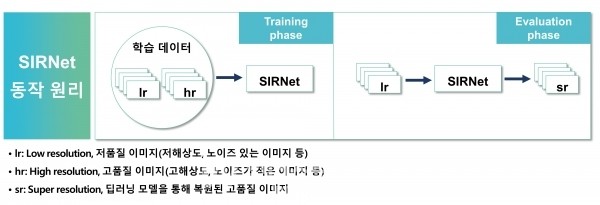
How SNUAILAB's ‘SIRNet’ technology works [Source: SNUAILAB]
Supporting more efficient inspection with a range of references
SNUAILAB's AutoCare platform provides △ a ‘detector (DX)’ that can serve deep learning-based object detection and recognition models, △ a ‘trainer (TX)’ that supports self-directed retraining so that on-site retraining can take place for the detector, and △ a ‘video management function’ for creating and streaming video channels, monitoring, and displaying analysis results.
Depending on the vision AI solution they want, customers can request additional customization based on AutoCare Reference Apps pre-packaged by SNUAILAB, such as Safety Vision or Traffic Vision. Where a similar app already exists, customization can involve additional training with site data to raise detection accuracy in the customer's process, or adding user events.
Customization is possible even when no similar app exists among the references provided. However, SNUAILAB noted that it is difficult for customers to apply a solution on their own. “When no similar app exists, additional model development, initial training, and tuning are needed depending on the solution,” Yoo explained. “In that case, the scope of customization must be decided against the AutoCare Reference Apps and a separate new app developed.”
“Customization matters because it shortens the time it takes to put a developed model into actual inspection,” he continued. “Previously, hundreds of images had to be trained before an inspection model could be put into a process. Based on the references SNUAILAB provides, an inspection model suited to the customer's site can be created by adding just a few images needed for training.”
Plans to expand and advance the platform
In the second half of this year, SNUAILAB plans to expand its solutions based on the AutoCare platform needed for industrial safety and machine vision inspection. Specifically, in industrial safety it will provide hazardous-object approach alerts related to worker safety in factories and identification of whether safety equipment is being worn. It also plans to extend to entry and exit counting in specific areas and spatial congestion analysis using heat maps.
In machine vision, it plans to expand its solutions around in-line application for secondary battery cells, using a Super Resolution preprocessing engine that restores high-quality images through deep learning models, and dedicated battery cell vision inspection software that applies segmentation.
It will also advance the AutoCare platform, with the aim of ensuring stable retraining at customer sites while helping customers carry out maintenance themselves. To that end, it plans to expand overall solution functions and to broaden the AutoCare Reference Apps so they can be used in a variety of solutions. It also aims to enable vision AI apps to be developed and deployed as a cloud SaaS service.
“AI technology keeps advancing, and vision AI in particular is moving even faster, so it is important to embrace new technologies and apply them,” Yoo emphasized. “Based on a university campus, SNUAILAB will keep working to build products and solutions that can be used on the manufacturing floor, drawing on the AutoCare platform and research from Seoul National University labs.”
[Industry News, reporter Cho Chang-hyun]
Source: http://www.industrynews.co.kr/news/articleView.html?idxno=50377